Wednesday, 26 August 2015

So, What's Wrong With Euthanasia Anyway?

via


My favourite private student of all time was a consultant pathologist who decided, in his ample spare time, to learn to speak French. He was already quite fluent when he came to me for lessons, so I was mostly helping him hone his debating skills in French.

He was great fun to talk to, because he was as opinionated as I was, but happy to actually listen to what I said. He also had this scientific mindset, which meant he would generally bring up himself the objections he could see to his own arguments, but he didn't like my philosophical ones.

Why do I mention him, I hear you ask?

As part of the course he was doing, he had to practise debating about a chosen controversial topic, and he had chosen euthanasia.

Something that is unfortunately getting into the news here in the UK, as the "Assisted Dying Bill" is going to be voted on soon. This bill will allow (or require? as usual this is left nice and vague) doctors to inject or give a lethal dose of medicine to terminally ill patients.

So, what's the deal with that? Why is it a problem?

Andrew (my student) brought up a number of objections to the bill (although he kind of supported it) himself.


  • He mentioned the evidence mounting up in the Netherlands and Belgium, showing that (unsurprisingly) people were being bullied into euthanasia by family, that doctors were over-stepping the mark, etc.


  • He admitted that hospices and palliative care were actually excellent systems, under-funded, but with a very clear and positive impact on end-of-life quality.


  • He mentioned that the main reason people chose euthanasia in those countries was the fear of being a "burden" to their families, with its dangerous overtones of the aforementioned bullying, but also of our failing as a society to make the terminally ill feel valued (as an aside, making euthanasia legal is only going to make that feeling worse).


In short, he didn't so much advocate euthanasia as oppose "acharnement thérapeutique" (it's a great French expression to describe a relentless and invasive string of procedures the terminally ill patient undergoes for very little benefit, just because no-one likes to just give up on treatment and focus on care). And as far as that, I could agree with him.

That sometimes the best choice is to stop treating a patient, and focus on pain-relief instead, is something I have first-hand experience of. Andrew would also have added, with his love of numbers, that "acharnement thérapeutique" does not statistically prolong the patient's life, good palliative care does.

Where we parted ways however, is exactly where this new bill stands. He was in favour of doctors actually giving a lethal dose to patients, but that is where I drew the line.

DNAR and palliative pathways are not active. They are simply acts of acceptance. Death will come for all of us, and sometimes the best course is to accept that, and relinquish control. 
Even unplugging someone from life-support can be relatively passive. It's a stopping of treatment, not the active administration of something that is going to kill the patient.
Even when doctors prescribe doses of pain-killers that are tethering on the threshold of dangerous, they are accepting a risk for a benefit, and that is what most medical interventions are.

What I oppose with all I am, is asking doctors to actively kill their patients. The objections I mentioned above are true and valid, but the one that carries most weight with me, is that you cannot demand that someone kill someone else in cold blood.

My dad is an anesthetist, my husband is a medical student. They do not deserve to be made to kill. 

I remember my dad telling me about the first time he unplugged a patient, and how terrifying it actually was, how he could not shake the feeling that the patient, in his deep coma, could tell what he was doing. If stopping treatment could have this effect, then what would actively killing do to doctors?
Killing someone, actively ending someone's life with an injection or a pill, is not an act without consequences. We are bargaining with doctors' souls when these are priceless. 

I know some doctors will agree to doing it. I don't think that is a good reason to let them. I often actively choose to do what will be harmful to me. 

Ask any smoker you disapprove of.

And I am sure the bill will come with some clause, allowing doctors not to kill if they don't want to. Just like they did with the Pill OB/GYNs and GPs weren't supposed to be forced to prescribe. We all know how well THAT went.

As a society, we should oppose the bill for the sake of the patients.

As a member of a family of medics, I object to it for the sake of the people I love. 

Also, as an immigrant, I cannot vote. Please, citizens of the UK, step up!

Update: I keep saying "doctors" because they are the ones who would have to do it according to the bill, but all this is true of all human beings.

Monday, 24 August 2015

So You Want to Join the Backward Bigots? This is What It's Like (In France).

Hello, Internet! I'm back!

Yes, I left. 

Well, then pretend you did notice.

We were on holidays where no internet was to be had, hence the quiet around here. But I had lots of ideas percolating in my brain in the meantime. 

One of which was about being (trying to be) a faithful Catholic in this day and age, and especially how it compares to what I read about America on my favourite blogs.

Being a Christian in Europe is generally an extremely counter-cultural thing to do. It's not like America, politicians don't even pay lip-service to some vague deity. Being a Christian is an embarrassment as far as they are concerned.

So I figured I'd explain how it feels from the insider view, both in France and in England, and the challenges we face.


***

So, what is it like, being a Catholic in France? (In my limited experience, I did after all, live in England when I reverted).

Often, it is lonely. It's hard to find people who agree with your views, or are willing to consider them valid thoughts.


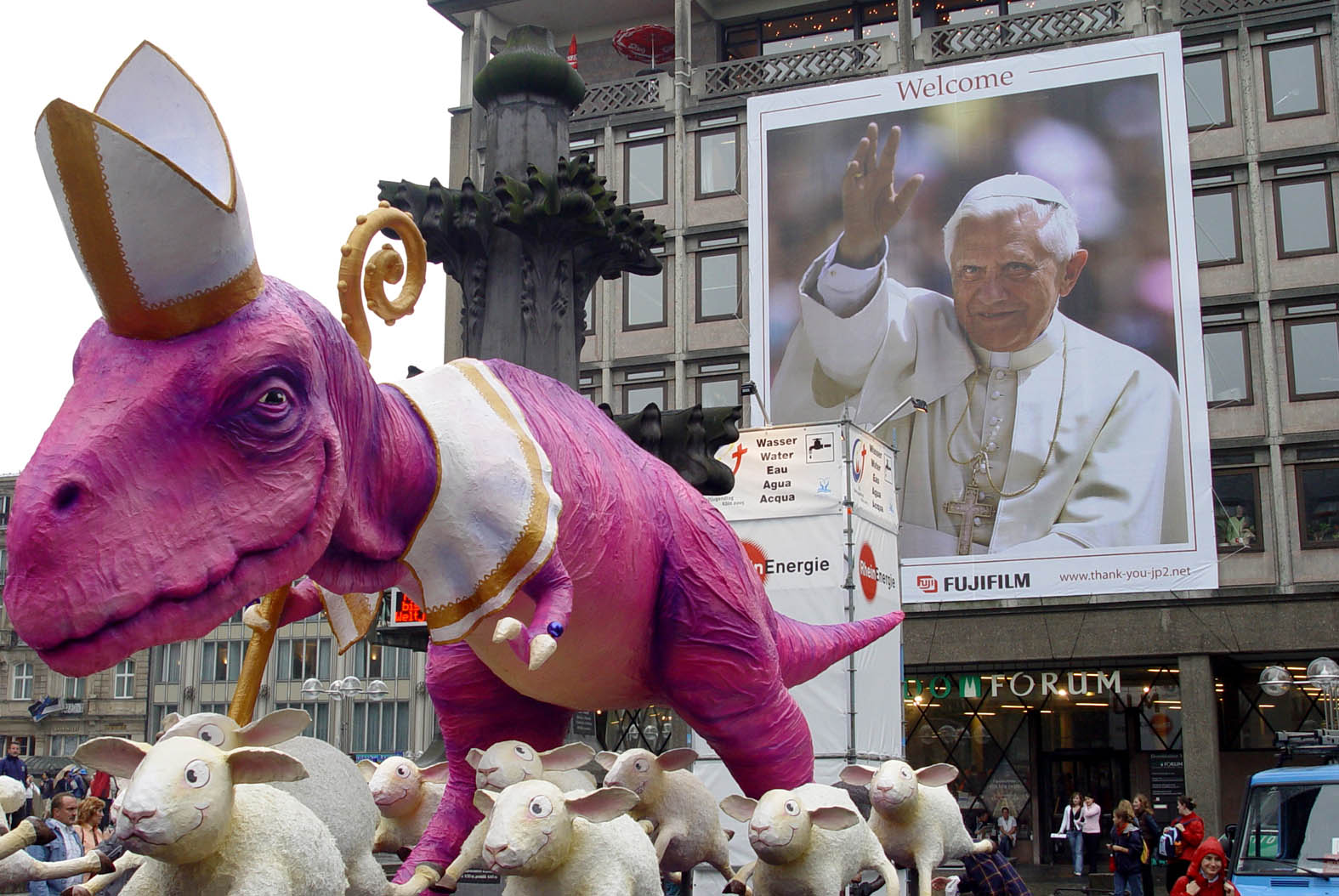
Catholics are sheep because they don't follow the majority opinion. It all makes sense now.


In France, Catholicism is still (just) the default religion for most people. There are a few Protestants, a few Jews, a growing number of Muslims, but culturally, it is a Catholic country (in name at least). Basically, if you are One of Them Bigots, people assume you are probably a Catholic bigot.

This means that you are not afforded the protection of a religious minority. Even though, really, you are. (If you are trying to follow some of the most controversial teachings of the Church, on marriage and contraception in particular, whilst believing in the Real Presence, you are a teeny tiny itsy bisty minute minoritette - that's smaller than a minority - basically, there are about three of you. On a good day. But I digress.) So, because you are perceived as a not-minority, you are fair game, in the way that Jews or Muslims are not (of course these groups also face discrimination, but it is more likely to be on a racist than a religious basis. I know, pick your poison.). 

What I mean is that it's ok for people who consider themselves broad-minded (they have a Muslim friend) and liberal (they have a gay friend), who hold for tolerance and freedom and sunsets, to hate you. 

Because Catholicism is perceived as a majority religion, people already KNOW it is a backward, women-hating, gay-hating, AIDS-propagating organisation of Evil. After all, they grew up with a Church in the background, celebrating Christmas and having chocolate eggs for Easter, they know all there is to know about Christianity. So they can dismiss you, and happily wait for you to recognise the errors of your ways, without ever actually listening to what you have to say. They will also be extremely violent in their rejection of you, since it is "allowed".


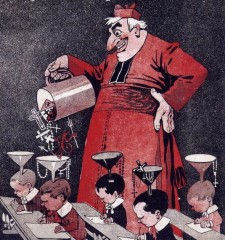
See? Catholics are preventing children from learning to read!


You also get to be marginalized by most other Catholics as an "Extrémiste". 

There is still a large number of people who will be in the above situation, already KNOWING that the Church is wrong, but still coming to church some Sundays (although their numbers are dwindling), still being involved in the running of the parish, whilst openly saying that they are against its teachings. I am not saying it's altogether a bad thing that such people are staying (I may not flout the Church's teaching on marriage and contraception, but I do it in other ways, every day - yes, there is a difference, because I am not asking the Church to change its teaching to accommodate my selfishness/laziness/fallen-ness, but the point stands) yet it remains true that you are going to be marginalized even in church, unless you go with the flow on divorce, gay marriage, women priesthood etc.

It's fun.

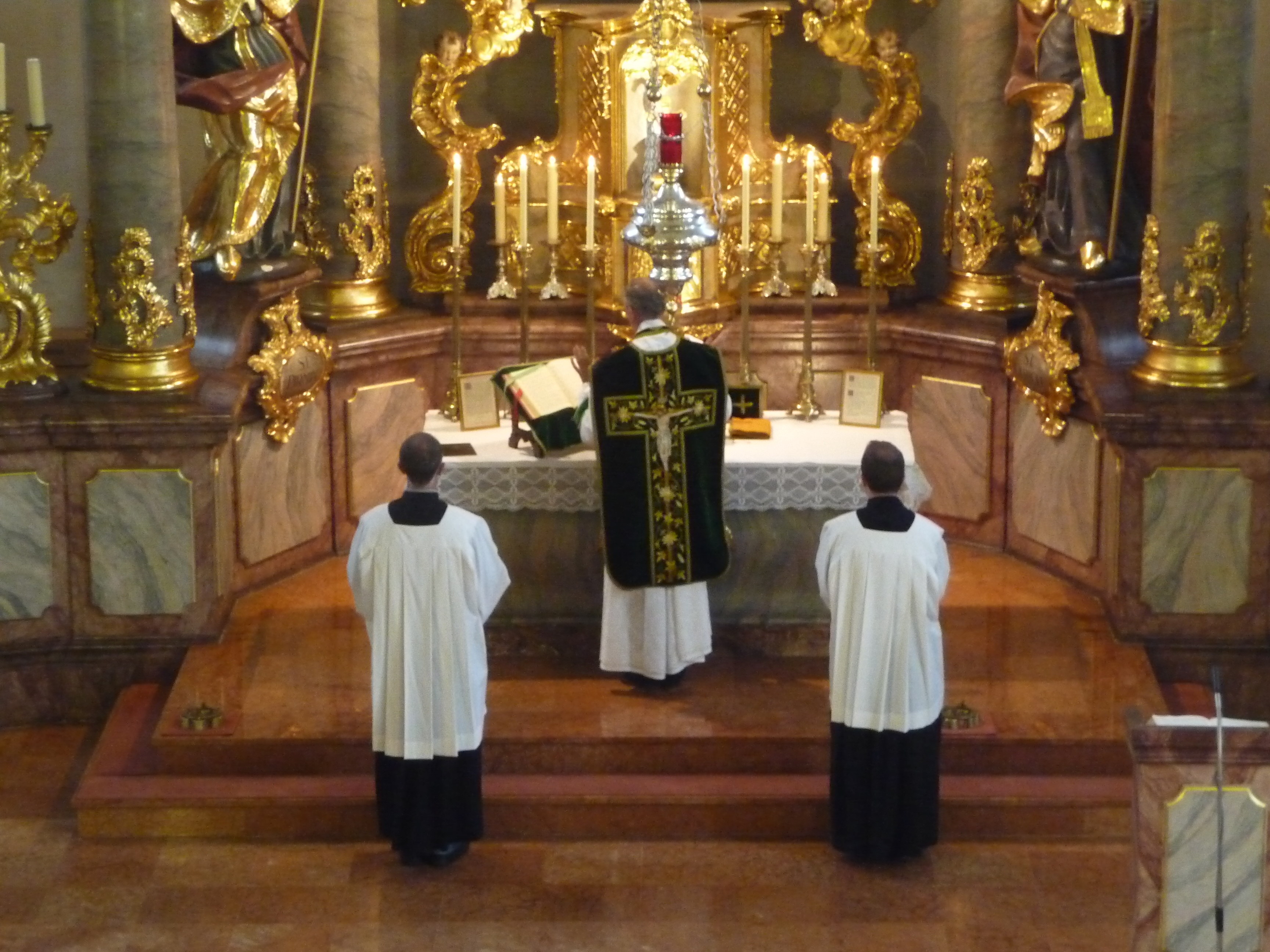
On the other hand, the still Catholic-in-Name-ness of the country means you can get beautiful services and beautiful churches (in the parish where I grew up, the newest church was from the fifteenth century). And some of the major Holy Days are also holidays. So that's nice. And you won't have to go too far afield to find a church where they won't hold hands during the Our Father, and you won't stand out too much (pun intended) when kneeling down for consecration. (Apparently Vatican II did away with all the pomp and ceremony. So I am told.)

Also, the "Tradis" (holding for a 2000 year old Tradition instead of the fashionable opinions du jour) have been discriminated and bullied on and off for two hundred years, so they are pretty well-organised. The Benedict option is alive and well in France, you just have to go find the hotspots (Versailles is generally a good bet, a lot of the Catholic resistance was organised and led by the put-upon nobility during the Revolution, so some of the largest communities of Tradis are where there were lots of old families congregated). 

Apart from such hotspots, there are some communities scattered about, generally gathering around a more orthodox priest. Typically, people will know which one is the "Tradi" parish, and avoid or join accordingly.

These groups are heavily stereotyped as royalists, wanting to return to nobility-run Ancien Régime, and refusing to welcome in anyone who does not agree with all the terms. I have no idea how true this is (I suspect not very) as I never stay long enough in France these days to actually get to know new people.


There are other groups of course, this is only the "Versaillais" stereotype, but they are harder to spot (you have to start talking to people you don't know, and other terrifying activities, to find them out). There are also some seemingly irreconcilable divisions between Extraordinary Rite/ Novum Ordo groups, which is a real shame, as we are already a minoritette. 

Outside of the churches, France is an aggressively secular society (has been for a 150 years, one day I'll explain the history behind it, it's fascinating) - yes, with catholic holidays, because everybody agrees to more holidays - , and its laws don't allow for much religious freedom. 


This is one of the many newspapers entirely devoted to hating the Church which were about in the late 19th/ early 20th century in France. 


Many people have heard of the fact that in French public schools, it is forbidden to advertise your religious views, even by the way you dress. The idea is that everybody should agree to fit into the mold, and your conscience is your own private business.

There is no such thing as a conscience clause allowing you not to prescribe the Pill because it goes against your principles. 

 - On the other hand, people in France are much less likely to sue you over these matters, because they generally don't sue as easily as in America or England. So at least there's that. -

But good luck trying to get anyone interested in the conundrum you are facing! No-one cares much about the freedom of the employer, or the opinion of the tax-payer. 

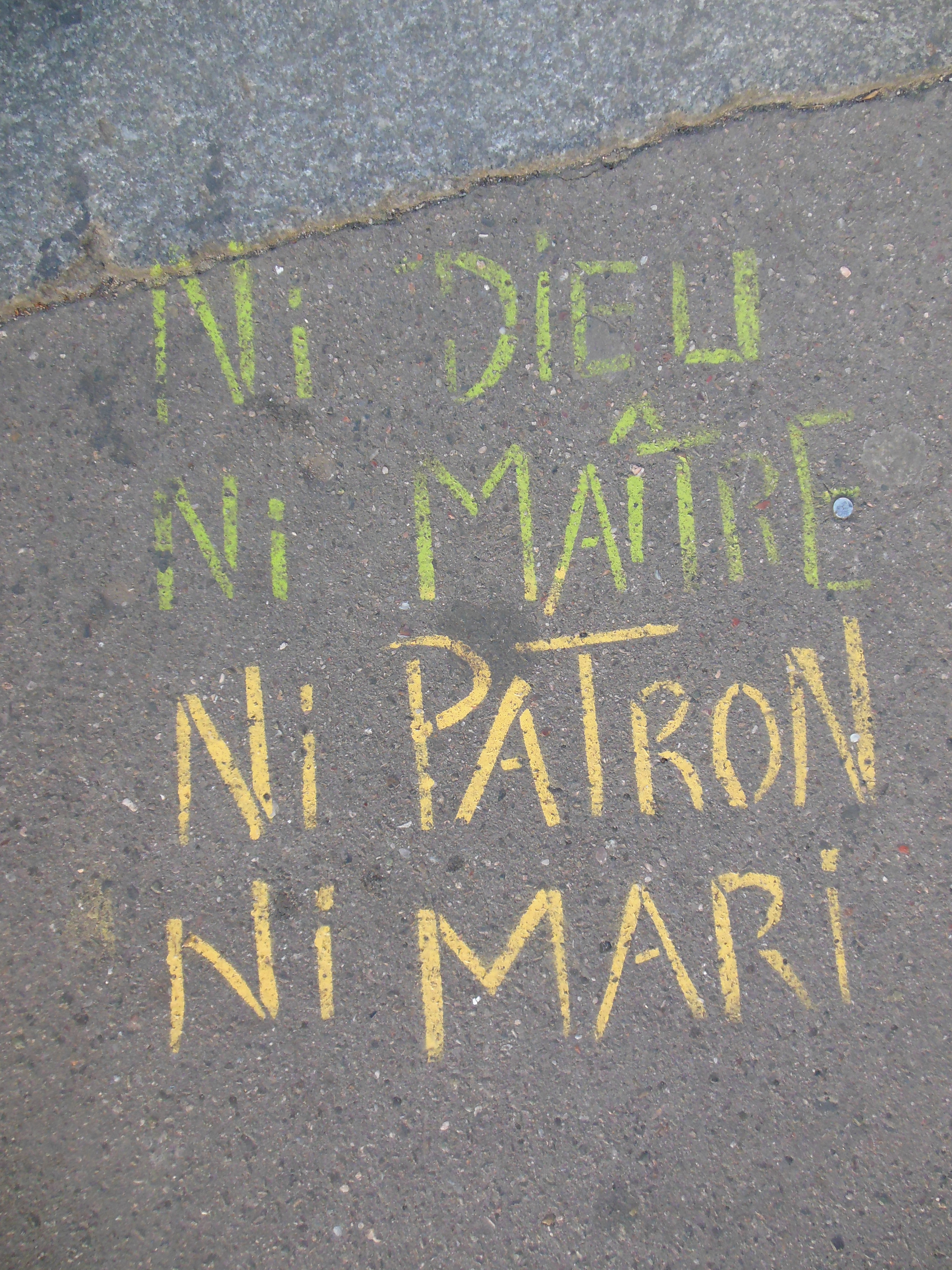
As far as a large portion of the public opinion is concerned, employers are part of this Evil Group of Evil, so their rights are not a popular thing to uphold (one of the most often-used chant in demonstrations - the national sport - roughly translates to "just take the money from the bosses" -"l'argent, il y en a / dans les caisses du patronat"). 


No God, no master, no boss, no husband. An interesting, albeit complicated, lifestyle choice. (Via)


The fact that the free healthcare system is paid for by the taxes of people who may object to its practices has never been debated by anyone in my experience.

Education is also accepted as a State prerogative, and although homeschooling is legal, people are largely hostile to the idea of SAHMs which would enable it. People never question the fact that you are going to send your children to school or that the State should be in charge of its curriculum. 


More love from the French press for Catholic schools.


On a more positive note, it is considered extremely bad form for a teacher to share anything vaguely resembling political or religious ideas in a public school, and they typically don't do it, and avoid the difficult topics, like sex-education (as far as most teachers are concerned, it's not their job).

There is talk of introducing compulsory sex-education, but I am not sure how hotly debated it is, or if people will agree to it, or if teachers would do it, even if the law said so. In my experience, you learn about the reproductive systems as part of your biology classes around the age of 12-13 and that's it.


A more recent one to advertise the petition demanding that Catholic schools lose public subsidies unless they teach gender theory.


The private school system in France is slightly peculiar, as the best schools are typically state-run (it's a geography roulette) but even Catholic schools have to toe the line to a very large extent. 

So, where does that leave you, member of the Backward Bigots Fraternity?

If you want to raise your children with a good understanding of the Church's teachings, you are going to have to do it yourself. The media will be against you, your children's schoolmates will be ignorant-to-hostile, your own parish will likely try to undo your work because the catechesis they offer is a dire blend of love-rainbow-butterflies, let's-skip-that-difficult-bit-here and you-don't-REALLY-have-to-do-it.

So, your options are:

Either to take refuge in one of the Tradis hotspots where other parents will be reinforcing what you are trying to teach and the parishes are likely to be run by these same people. You will be cut out from the world to a certain extent, but you won't be alone.

Or try to take on the whole world on your own and start gathering a community around you to help you do it. It is hard, but probably do-able, provided you know enough people with similar views, are sociable (I'm not) and can take a few differences of opinion (I'm working on it).

But, if you are a French Tradi, you probably already grew up in this environment and your family is supporting you. I am yet to meet another French revert from Lukewarm Pick-and-Choosism. (Hi! Want to be friends?)

Feel free to disagree in the comments if you have a different experience.

Tune in next time for the English experience!

Sunday, 16 August 2015

A Few Thoughts on the Migrant Crisis


So, in the past few months, more of the migrants fleeing the Middle East have managed to reach Europe, and, predictably, although still sadly, the European reaction to the crisis has been a shameful rejection, mixed with a shifting of responsibilities between countries. 
Facebook is awash with grumpy commentators, scared by the newspapers, angrily rejecting their fellow human beings, scared of the squalor these people live in, whilst comfortably sipping tea in their own armchairs.

Yes, it does make me angry.

Does it show?

I know a tiny bit of what it feels like to move to a foreign country on your own, albeit a country not too far away, and with the option of going home still wide open and easy to reach. And yet it was still terrifying. I can't imagine what it would be like, if you couldn't go back, if you had no resources and your own embassy could be your worse enemy.

Although I obviously only see the British reactions, what I have seen on Facebook is rude and painful. Painful to me, as a migrant myself, painful to us as a nation, painful to us as a part of humanity. And this is compounded by the British selfish attitude to its own difficulties, when it is bearing a much lighter load than many other European countries, without mentioning the crises faced by Turkey or Egypt. 

Britain is being the teenage girl on the hiking expedition, carrying the lightest bag and complaining the loudest (yes I can relate, that was me, but at least I knew it was wrong).

There are some common misconceptions that crop up again and again. Immigrants don't do a comparative study of social security systems, before comfortably making their way to the most promising country, where they can get the most money for the least amount of work. These are desperate people, who have fled in a hurry, who find shelters overrun by their peers and carry onward, following a vague rumour, or the promise that So-and-So's cousin lives in England, and in all his letters home, trying to justify abandoning his entire life to move to a foreign country, he was always saying how the streets are paved with gold, how people bow to him when he goes anywhere and how the Good Life is there. 

Most of the time, they will try to reach a country where they know someone, anyone. Because that is less scary than knowing no-one. This has always been the case. Why do you think there are such things as Chinatowns in most major cities? Why do you think all the Irish immigrants went to Hell's Kitchen? They knew someone there. 

No-one goes country-shopping.

And yes, these people are desperate. And yes, they do not stay in France, Mr Facebook commentator, not because they are not desperate but because they are hopeful. France is struggling? Maybe the next country will be better. Or the one after that. And they drag on their own misery, from port to train station, from rapacious human traffickers to unyielding policemen.


So, Mr Facebook commentator, before you complain about immigrants coming to your country, stealing your tax-money, maybe you should ask yourself Figaro's question in the Marriage of Figaro (the play, not the opera, the opera is all fun, whilst the play is all political manifesto): What have you done for all the goods you have? For your social security, stable country and freedom of expression? You gave yourself the trouble of being born, and that is all.

And yes, we should be involved in this crisis from far away, we should be concerned.

No man is an island,  entire of itself; every man is a piece of the continent, a part of the main; if a clod be washed away by the sea, Europe is the less, as well as if a promontory were, as well as if a manor of thy friend's or of thine own were;  any man's death diminishes me, because I am involved in mankind, and therefore never send to know for whom the bell tolls; it tolls for thee.

John Donne.