Showing posts with label Lost in Translation. Show all posts

Friday, 1 December 2017

Lost in Translation: School Uniforms

For this here blog re-launch, I have decided to also dip again in the always fruitful Lost in Translation segment, this time tackling an issue which first caused me intense bewilderment before I just gave it up altogether. 

School uniforms.
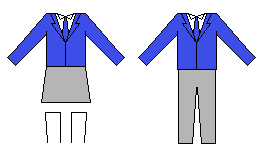


Put yourself in my shoes: I grew up in a school system where school uniforms were all but unheard of (including in religious schools) and where teachers could - they mostly didn't, but they could - wear all kind of eccentric garments (my favourite remaining to this day the epic complex-landscape-with-houses-etched-across-a-brownish-trouser-suit that my Latin teacher used to wear - it was epic, you should have seen it). And yet, the common issues used as arguments for a school uniform were and still are also absent:

- people (yes, including teenage girls) dress according to the weather
- their clothing is typically modest
- the behaviour of students is certainly no worse than in England
- kids have no trouble feeling like they belong to their school and that other children who are not from said school should therefore be shunned (yes, they are able to work that out even without the help of designated blazers)
- bullying over clothes is no worse than in the English schools I worked at (sorry to break it to you, but English kids are just as able to pick on be-uniformed peers, they just make fun of how clean the uniform is or focus on bags, shoes and hair-dos).
- they seem to be able to recognise and follow or rebel against arbitrary rules just as well as the British

So I really struggled to see the point of adding to my already heavy workload as a teacher by having to pretend like I cared deeply whether the students were tucking their shirts in, wearing their clip-on tie, asking me before they took off their blazers, and following the one million rules on how to wear your hair up or down (because if your hair is down it will get caught in stuff and you will DIE, as demonstrated by the astronomical rate of death-by-hair recorded amongst French kids).

I had to remind myself constantly to Be cross! It's disrespectful! Don't forget to make them fix their clothes! when really they looked just fine to me. I listened to countless parental hand-wringings over even the smallest issue - clip-on ties were a particular favourite: When are they going to learn to tie them if they don't have to wear a real tie as part of the uniform? as one anguished parent once asked (I don't know, you could always, maybe, just show them?) - Luckily I knew how to answer that one: I just needed to look grave, shake my head and utter in hushed tones - I'm so sorry, it's a health and safety issue you see... - 
I had teachers explaining to me that they once worked in a school where the kids only had to wear a polo-shirt and jumper rather than a shirt and blazer, and the behaviour.was.appalling, Isabelle, APPALLING! (everyone knows that all behaviour issues are solved by clothing, as the immaculate behaviour of toddlers wearing their Sunday best amply demonstrates.)

In the end I did acquire the automatisms needed to berate the students appropriately, but I never managed to care. I collected  reason after reason from as many sources as I could in an almost anthropological effort to try and see the point of it all, and whilst I can give you as many reasons as the day is long, I don't believe in a single one of them. Sorry England. I tried ever so hard! 

But I can't even escape it now, because now I am a parent myself, and belong to groups of other parents, and they love to care about this stuff, to the tune of 100s-long comment-threads on Facebook at the slightest provocation. So, as this is my blog, I am going to take matters into my own hands. It's not going to be easy to hear, but it's for your own good Britain.

Wait. First you will have to come a bit closer, because it's a secret and we are about to stop pretending:

Are you ready?

Ok, maybe go make some tea first, to steady your nerves.

Back?

Ok, I'm about to take the plunge, hold on to your screen.

Here goes: the only actual reasons why your kids wear school uniforms is because 
a- it looks nice
b- that's how it's kind of always been

That's it. 

So, my dear anguished parent brethrens, you have my official permission to stop caring. It doesn't actually matter any more than the weird rule about not sitting on the grass patch on the left in the Jardin du Luxembourg whilst the one on the right is totally fine.

It's probably easier to just follow the rule, but you don't have to think there is any reasonable argument behind it. 

Done.

Now we can start fighting about attendance rewards instead.

Wednesday, 5 August 2015

Lost in Translation: The North

When you travel on British motorways, you encounter strange signs, informing you that you are travelling to "The North" or "The South". Because they are places, regardless of which cardinal point you are following.


Photo: Alamy

So, yes, you could be heading south from Scotland, and still, technically be going to The North.

Now, I am aware most places have a north (this is a Doctor Who quote, what can I say, it's that kind of a blog), and in France we've even called one department "Nord" (it was a low-inspiration day in revolutionary France - unlike when they named the Côte-d'Or department which boasts exactly no coasts [yes, "Côte" can also mean hill, I am fully aware I am being disingenuous {I think this parenthesis thing has just got out of hand}]-).

BUT! I have a point!

The North v. South opposition is serious business around here. Parisians do make fun of Northerners, but they also make fun of Southerners, and the rest of France unites in despising the Parisians. Whereas in England, you are faced with two camps who refuse to speak to each other (they even use code to confuse the opponent, just ask a Southerner where the cob-shop is).

The funny thing is, beyond accents and vocabulary, I am yet to understand what are the actual differences between Northerners and Southerners. England is only small, and they are the same region by French standards (and decidedly neighbours by Amercian ones). And yet, and yet. For some reason, you mustn't confuse the two. I offer no explanation for this, I only know that, apparently, it matters dreadfully.

The other tricky thing is to try and pin-point where the North starts. The further south you go, the further the imaginary border follows you down, whereas the further north you go, the more you reduce the officially "northern" area behind you.

Nope, makes no sense to me either.

Plus it leaves the poor Midlands stranded, rejected by both North and South whilst trying to identify with both. 

Bless your heart, Birmingham. At least the Midlands have the Peak District (although I wouldn't be surprised if the Northerners suddenly decided to grow more tolerant and include Derbyshire in their reckoning just to steal that one from you as well). 

And don't come telling me it's grimmer in the North to explain all of this, South, face it, the English weather is grim everywhere. Just be civil to each other and share your umbrellas. (You see, when I do the test to find out how northern I am, they put me somewhere beyond Jersey, where the map doesn't go).

Monday, 3 August 2015

Thoughts on the Ashes

If you are in any way not British or Commonwealthish, you may have come to this post thinking this was going to be a deep philosophical reflection on the transient nature of thoughts or anything equally high-brow.

If you are British or Commonwealthish, you already know, right?

I'm totally talking about cricket. 

Again.

So, we've been going a little Ashes-crazy over here (talk about emotional roller-coasters! - Or don't, this is cricket after all). 

For non-cricket people around here, the Ashes are the name given to any Test (i.e: 5-day long) series between England and Australia. They have 5 Test matches to play in this series, and so far, England won one, lost the following one, and than won again. Two more 5-day matches to go!

Believe me, it's very exciting.

I promise.

The name "the Ashes", according to wikipedia, comes from a journalist writing a fake obituary declaring that English cricket died and that its ashes shall be buried in Australia, the first time Australia won on English soil. (As an aside, if you type "ashes cricket" in England, Google simply takes you to the scores, whereas in France, it takes you to burnt bugs, or the wikipedia page).

Yup, yup, they totally do the arcane traditions on purpose.

Apparently it contains the ashes of a cricket bail, for authenticity (via)

It is actually the smallest, most ridiculous trophy ever (it's only six inches tall). Go here if you want to see it in scale.

So anyway, as long as the Ashes are going on, this is what Sunday mornings look like at our house:


And we've been teaching a few basics to Patapon.

No, no, no, Jude, that's not the sign for four, that's the sign for six!


(No, no one seems to have told cricket fans that there already was a universally accepted sign for 4, or that it was a lot more self-explanatory than waving horizontally.)

What he's been really good at, though, is declaring people out.

That's it. Bus Driver, you're out!


Phone-Guy, you're out!

And the Lady Friend, out!

You too, lamp-post, you're out!

Mmh, I wonder... LBW?

Just one more thing, if you are planning on becoming an internationally acclaimed cricketer, try not to have a "oo" in your name. It sounds like people are booing you when they shout your name, Patapon finds it upsetting (looking at you Joe Root).

Tuesday, 16 June 2015

&%#%*@ English Weather

Dear English Weather,

Since there appears to have been a certain amount of miscommunication between us, I am going to explain to you what we need VERY SLOWLY, so you understand.

This is the current month we are in:


Not this:


And I am not interested in the amount of alcohol you have ingested in order to be this confused. Listening to your excuses would only be encouraging you.

Now, SUMMER, is like this:


via

Not this:


via


Temperatures should be like this:


Via


Not this:


via

Again, I DO NOT care that summer officially starts in 5 days. The very LEAST you could do, English weather, is make it feel almost summery, when it is almost summer.

I want to wear this:


NOT this:


My coat is in the loft, WHERE IT BELONGS! Because it's JUNE.
I have a lot of extremely cute short dungarees Jude needs to wear. You are wasting everybody's time and money, Weather.

And none of that: "Look it's sunny! Go outside! Wear all the summer stuff! @#%& it's windy and freezing..." routine. That's just cruel and unnecessary. 

Understood?


I'll be watching you.

NB: So far, you seem to have been listening to me today, Weather. I'm STILL watching you.

Tuesday, 26 May 2015

In Praise of the Goûter : The Answer to all your Snacking Woes

So, Dwija wrote this post a few days ago, as an answer to another post. Now I feel it needs a post to answer it in its turn, in a beautiful chain of blogging chatter. (It's the ciiiiiiiircle of Liiiiiiiiife!)

What Dwija says is this: she chooses to offer snacks to children who come to her house, because it is a very important gesture of hospitality for her, even though she knows (now!) that some parents object to it.

Well, I've got a solution to the problem: don't give the kids snacks, give them a goûter.


We like it so much, we named a mountain after it.


You see, people don't generally snack much in France, and it is certainly not encouraged. My mother, for example, would offer me a glass of water if I said I was hungry between meal times when I was little. My grandmother is actually horrified people carry food around and have sandwiches on the go rather than sit-down lunches, so let's not even go into her opinion on snacking.

This attitude is due partly to the fact that it is considered unhealthy, but mostly because it is EXTREMELY important children should eat what is set in front of them for each meal. Picky eating is not considered quirky, but bad manners, and it is easier to overlook personal preferences if you've worked up a nice appetite before the meal is served. (Mealtimes in France are an international treasure, so there. Gotta respect that.)

But I see you are now worried that life as a French child is a vale of sorrow, where no fun food is ever offered, and kindly people like Dwija are condemned as destroyers of UNESCO Intangible Heritage. 

Not so, not so.

Because we have the goûter.


Patapon is very sad goûter is over.


The goûter is a special mini-meal children eat in the afternoon, generally immediately after school, which then enables them to wait happily until dinner is served (which is typically between 7-8 pm). During this special mini-meal of bliss, no-one expects to eat healthy food. In fact, chocolate (or even better, pain au chocolat) and treats  are the norm. All the snacky food is available. All the breakfast food is available. There is no rule of eating what is set in front of you, but a free-for-all of daily indulgence. It's fantastic.


All the treats


If my Mum didn't feel equal to making dinner, wanted an early night, or had nothing left to make a proper meal, she would proclaim "Goûter-Dîner" night, and the delight would spread through the house in an instant, as each sibling announced to the next that TONIGHT, we were having all the treats for DINNER!

I also remember the sense of panicked grief I felt when, age 17, as I was having my goûter at a friend's house, her father said: "You're really getting too old for goûter now, aren't you?" (No we weren't, Hervé. Still aren't. We just have it with tea now, and pretend it's not the same thing).


Having goût... erm, "afternoon tea" in Berlin


It was expected, that if I was going to a friend's house, of course they would give me my goûter. And it ticked all the boxes Dwija needed : it doesn't require cooking, so it isn't a problem for the host family to provide it, it is a sharing of food, which humans have always associated with deep fraternizing since time immemorial, plus it has the advantage of not encouraging snacking between meals, which just ruins people's appetites. 

So here you go world. If you learn just one thing from the French, make it the goûter.

You won't regret it.


Wednesday, 20 May 2015

How to Sleep Like a French Baby

These days, I mostly hear how lucky I am that Patapon is such a great sleeper. And yes, he does sleep between 11 and 12 hours every night, and slept at least 8 hour stretches from the age of about 2 months. So, basically, we struck parenting gold, right?

Well, I am not so sure. He is not that great a sleeper by French standards.

And I also remember the first two weeks of his life very vividly. Clutching the screaming infant who would. not. sleep. Ever. Calling in despair various people, who would all offer commiserations but little hope for the next few months.


Yes, I will have a think about that "sleeping" idea of yours, Mother, but I don't like the sound of it.

I was following all the advice I had been given by the midwife and health visitor: 

  • Patapon's Moses basket was next to my side of the bed (although it was mostly for tripping over, as he refused to stay in it). 
  • As soon as he made feeding noises or gestures ("clues") I would feed him, and not wait for him to get all worked up.
  • "You can't spoil a two-week old."
Patapon would only agree to sleep in someone's arms, so Simon and I took turn having cat-naps, but then, after about 5 minutes, Patapon would express a "clue" and Simon would have to wake me up. Jude would fall asleep almost as soon as I started feeding him, yet would wake up the second I gestured towards putting him down, even next to me on the bed. But DON'T FALL ASLEEP WITH THE BABY IN YOUR ARMS! was the advice.

All the fun, all the time.


Then my Mum came over, and took matters into her own hands. And it worked. 

So, I give you:


The French Method

Tested and approved by most of the the French babies I know, and most certainly by the 11 babies my grand-mother, mother and I have had between us so far.

(Catchy, hey!)

This is my baby Mum, approving.

Basically, there are two ideas:

1. Don't pick up the baby straight away.
2. Feed at regular intervals, not on demand.

There is also a general spirit of not over-thinking the decisions, not imagining dreadful implications or believing the scare-mongering. It is more: 

Right now, your child needs food and sleep: here is what I know works so you can actually provide these things, rather than a general "philosophy" you like and to which you cling with whitening knuckles as your sanity slowly oozes out of your sleep-deprived brain.
You love him, you feed him, he sleeps? He's fine. 

But here is the nitty-gritty of the method (please imagine that this is my Mum and my Grandmother talking to you, not me, they have a lot more credibility):


Don't pick up the baby straight away


The idea is to wait a few minutes when you hear your baby cry. But that means ACTUAL minutes, not I-swear-it's-been-ages hormonal minutes. (Not that I have been there or anything...)
This is to help your baby connect sleep-cycles without fully waking up, and therefore gradually sleep longer. If you check on him straight away, you will wake him up fully (or so I hear... erm... moving on...), whereas if you wait a bit he may just fall back to sleep, into the next cycle. If he is fully awake, you go pick him up after those five minutes and check what is wrong. 


Such sleeping.


Problems: 

- You need to start this straight away if possible, and before the baby is 3-4 months old anyway. After that, it's not going to work.

- I am not sure how well that works with co-sleeping as this practice is extremely uncommon in France and I personally didn't particularly want to try it. 

Patapon only slept in our bedroom for a couple of weeks, because we would wake each other up constantly. When my Mum arrived she declared the NHS advice officially failing and we started putting him down in his own room. (Worry not, our house is tiny, we could hear him very well still.) 

- In Bringing Up Bébé, Pamela Druckerman gives this as the one and only thing you need to do for your baby to sleep through the night. It wasn't enough for me, I had to also follow Piece of Advice number 2. But this may be because of the whole sleeping-in-arms thing Patapon had going.

- For us, we first had to make him accept to actually fall asleep in the Moses basket, so for the first two weeks, the Pause wasn't really an option for us. 

With this problem, my Mum was all for letting him cry until he accepted the fact that this was his bed, not our arms. I don't have a problem with that, and we would have done it if all else had failed. Instead, I ended up spending a lot of time trying to soothe him to sleep in his basket, which did eventually work (nursing him to sleep didn't). It took a couple of days, but once he'd done it a few times, he was fine sleeping there without needing cajoling most of the time.

Bonus: to this day, the songs I used to sing him then make him all drowsy!


Feed at regular intervals, not on demand


The other thing my mum insisted I do is stop looking for clues and start simply spacing out feeds by three hours. We would try and distract Patapon if he woke up or started fussing in-between (that meant a LOT of walking him around in the baby-carrier), but mostly held out. I did occasionally feed him earlier if I knew he had not fed very well the last time (falling asleep in the middle for example).

Before that J. was asking to be fed constantly, but only nursed for a couple of minutes at a time. With the interval method, he was hungrier when I did feed him, therefore he nursed much better and then could hold out much longer. 

It made a huge difference almost overnight. Simon and I had a three nights when we took turns to go and comfort Patapon when he woke up crying before the "interval" was over, and that was it. After that, he slept at least the required interval, and gradually more. At one month we moved him to four-hour intervals during the day, but he was already sleeping at least 4-hour stretches at night. 

According to my Mum, that's pretty standard (apparently, I started doing 6-hour stretches at three weeks when my Mum begged me to - my big brother and I are nearly Irish twins, she was exhausted) . 


This is my clever face


The only case of regression she had was my little brother, he was about 8-weeks old, and sleeping 8-hour stretches, when we all went on holidays to the south of France, and the heat made him thirsty. But he got used to it after a few days and stopped needing middle-of-the-night nursing again.


Much snooze


Problems:

- My grand-mother says not to start doing this straight away, unlike the Pause, but to wait until the milk has come in.

- For those using NFP, the long stretches at night may cause early return of fertility, despite exclusive breastfeeding. It didn't for me, but I can't guarantee it!

- Some have suggested that spacing out like this will affect milk supply if you do it before the 12 week "established breastfeeding" mark. Breastfeeding is not as prevalent in France so I am not sure about that one in general terms, all I can say is that  it didn't at all prevent my grand-mother, my mother and I to exclusively breastfeed our babies for as long as we wanted.

- I have also heard people say that babies need to be fed more often than that because they only have tiny stomachs, to which I can say many things, including:
  • a tiny stomach, yes, but in proportion to a tiny body 
  • they also have a gut
  • it's actually good for the stomach to be empty every now and again
  • my grandmother and mother still managed to have absolutely enormous babies, so I don't think we were under-fed
Me, looking under-fed


Here you go. I hope this may be helpful for some people. Obviously, I don't claim expert scientific knowledge, nor do I think everybody MUST do the same thing as us. 

You do you, Internet. 

This is just what we did, following my mother's advice who had followed her mother's advice before, and it helped Jude sleep through the night pretty quickly, despite the fact that he traveled to Liverpool, London, Paris, Lyon, Paris again, the Atlantic coast of France, Paris once more, London again and then finally home, in the first month of his life.


Monday, 18 May 2015

Dear Britain: It's a bit more complicated than that. Love, The Surrender Monkeys.

So, these days it is pretty much agreed that political correctness has gone too far, that we can’t even say anything anymore, right?

Well, I’ve got good news for you people, you may not say anything about disabled people, Black people or Asians, but, hey, at least you can hate on the French!

Great, right?!

Couldn't find a cheese-eating one.


But, Isabelle, surely you are, maybe, I don’t know, a little bit too sensitive to it? Surely, it’s just banter, right?

Oh, probably.

Here’s banter:

We were in a bar a few years ago, when a group of people came to sit next to us (I don’t recall why, maybe the bar was packed).
One guy hears me talk to my friends and exclaims: “where are you from?” in a rather annoying and accusatory way. So I ignore him. Then a few minutes later, someone else asks me the same question (but, you know, nicely, and after having said hello or something) so I answer. The first guy immediately reacts:

Guy:_ I said you were French!
Me: _ No you didn’t. You asked me where I was from.
Guy: _ Stop being so f***ing French, or everybody’s gonna hate you.
So that was that.

What followed may have been:

a-   Hahaha, so witty! Such banter!
b-   I threw my drink in his face
c-   I left the bar

I leave it up to you to decide what would have been my most likely course of action.

Unfortunately, this happens quite a lot. And most of the time, it takes a pseudo-historical slant, as they explain to me how the French just didn’t fight the Second World War, because, Surrender Monkeys.

Now, I am a very meticulous fake historian, so let’s analyse that idea.

Are the French surrendering particularly often?


So, here are the last few wars fought by France (I’m excluding the colonial wars, mostly because they don’t have very much to do with surrendering).

WWII – surrendered

WWI – won (Before you start saying that it was only with America's help, may I point out that before the US joined, the French fought grueling battles for 3 years? That may demonstrate poor soldiering, but not excess surrendering.)

1871 – partly surrendered, although Paris chose the option to eat elephants instead (ask Kendra’s kids, it’s a great story)

1859 - won

1853-1856 - won (aah, the siege of Sevastopol, my - geeky - childhood)

1790-1815 – Conquered most of Europe. Was eventually limited to its own borders. Had to be thoroughly beaten twice before agreeing to the idea.

Let it be said that I do not approve of Europe-conquering. I am making a point.


1775-1783 – won (Froget us God / If we forget / The sacred sword/ Of Lafayette, right, America?)

I’ll stop. Out of these, most people calling me a Surrender Monkey only know the first two. A couple had known about Napoleon (the WORST Surrender Monkey there ever was. The guy was obsessed with it. Went to surrender all over Europe). The other wars have not yet been mentioned to me (but one lives in hope!). So basically, we are Surrender Monkeys, because we lost against Germany in WWII. But hey! So did most of Europe! Let’s all be Surrender Monkeys together! No?

All the monkeys

No.

Just you, France.

So let's explore this further. Why just France?

Was France’s surrender in 1939 particularly remarkable/shameful?


See above. Most of Europe! But let’s be thorough.

So, France was allied with Britain. They decided to attack Norway first. It went badly. For both (especially the Brits with no skis, but I digress).

Then Germany attacked, with the Blitzkrieg tactic, which no army yet had managed to counter. They also bombed the French air force still on the ground. So that was that.


Basically: planes destroy the rear whilst tanks + infantry push on one point then turn back and attack the armies from the back. No back-up or retreat possible as the rear is already destroyed. The tanks push on immediately to undefended and unprepared locations.

As you can see, Britain might have had a slight advantage there, with all of that blue thing going on around it. Tanks don’t float brilliantly I hear.


Most of the French troops where en-circled in the East, then the rest, with the British, suffered the same fate in Dunkerque.


So, eventually, due to woeful tactical errors trying to counter the blitzkrieg (I’m happy to claim them all for the French High Command – let’s say Britain knew better but didn’t dare say anything because the French are such scary Surrender Monkeys) the French and British armies got cornered in Dunkerque.
Churchill managed to get enough boats to get the British out of there. Great! Miracle of Dunkerque!

Can anyone explain to me how that’s not buggering off, leaving your ally in the sh*t? (Pardon my French.)

Don’t get me wrong, I’m glad they did, and France was indeed conquered, so might as well not let two armies get captured, right? Right. But it does seem a bit rich to then turn round to your abandoned ally and say, “you Surrender Monkey!”

Here is the Miracle of Dunkerque seen from the French side: 11,000 dead (including my great-grandfather) the French army fights on desperately for a few days on its own, fails to stop the Germans, they enter Paris. Britain, from the safety of its island, refuses to release France from the agreement to not conclude a separate peace (so what if there’s no France left to fight from? WE shall never surrender! Silly Surrender Monkeys!)  France surrenders all the same (because there really is no France left to fight from). Germany then takes most of the French army (around two million men) and sends them as POWs in Germany. Most of them didn’t return until 1945.

Two weeks later, the British attacked the French navy at Mers-el-Kebir. Nope, no declaration of war happened. Yes, like for Pearl Harbour. So that was a war crime. You Surrender Monkeys!

Once again, I think the British mostly did what they had to, looking out for themselves. But they can hardly claim a moral high ground. Or say that surrendering was shameful.

This image (the man is watching the German army parade in Paris) may or may not make me cry. We'll never know.


Maybe what people really mean is that France sat out most of WWII?


Now, we are finally getting onto something the French ARE self-conscious about. You see, before I came to England, I didn’t for a second imagine people thought we were Surrender Monkeys because they abandoned us at Dunkerque. I was, however, ashamed of what we call L'Occupation. Mostly because of one concept, that of Collaboration.

Once the French were conquered, the Germans set up a dummy state in the southern part of France. And these people, along with most of the population, chose to make do with the Germans, and try to carry on. Collaboration with the occupying forces was encouraged. Fascist ideology advocated.

Many terrible things happened because of this, and I really wish my country had not chosen that path. But it did.

There were, however, some reasons behind it.

a-   It’s hard to fight an occupying army when every single act of resistance is punished by the murder of dozens of innocent people (that’s the hostages system, it was used throughout France). So yeah, 'Allo 'Allo lied to you Britain.

b-   Apart from the specific hostages just lifted from the street to be killed in response to acts of resistance, there were two million French prisoners in Germany. Most families had someone who was a POW. Funnily, they seemed to care what happened to them. So, yes, they sat tightly on their bottoms.

c-   Sitting through WWII under German occupation was not exactly a picnic : France had to pay Germany for its own occupation (and the price was fixed by the Germans, so basically, it was just institutionalised robbery on a national scale). This led to rationing so extreme that unless someone was resorting to the Black Market (which was punishable by death) they would have died of starvation anyway. And all of this was done on purpose by the occupying forces. Now, it wasn't as bad as, say, Poland, but still not a picnic.

d-   Some of France did fight. When the Allies attacked North Africa in 1942, the French troops there didn’t fight back. They joined them instead - if you think El Alamein was a great British victory, please look at the role played by the French troops at Bir Hakeim to make it possible - . Germany dissolved the southern dummy state and just occupied all of France directly as a result of this, because even the dummy state couldn’t be trusted, apparently. And indeed, what was left of the French navy consequently chose to scuttle itself to avoid falling into German hands.

e-   Coventry and the London Blitz were bad. But look up Brest. And Le Havre. And Saint-Nazaire. And Royan. And Lisieux. 

Brest


f-    Paris freed itself. It’s a great story. All my A-Level students know about Commandant Gallois on his bicycle.

Liberation of Paris


So here you go. And don’t worry Britain, I still love you. Unhealthy attachment to inaccurate representations of WWII and all.